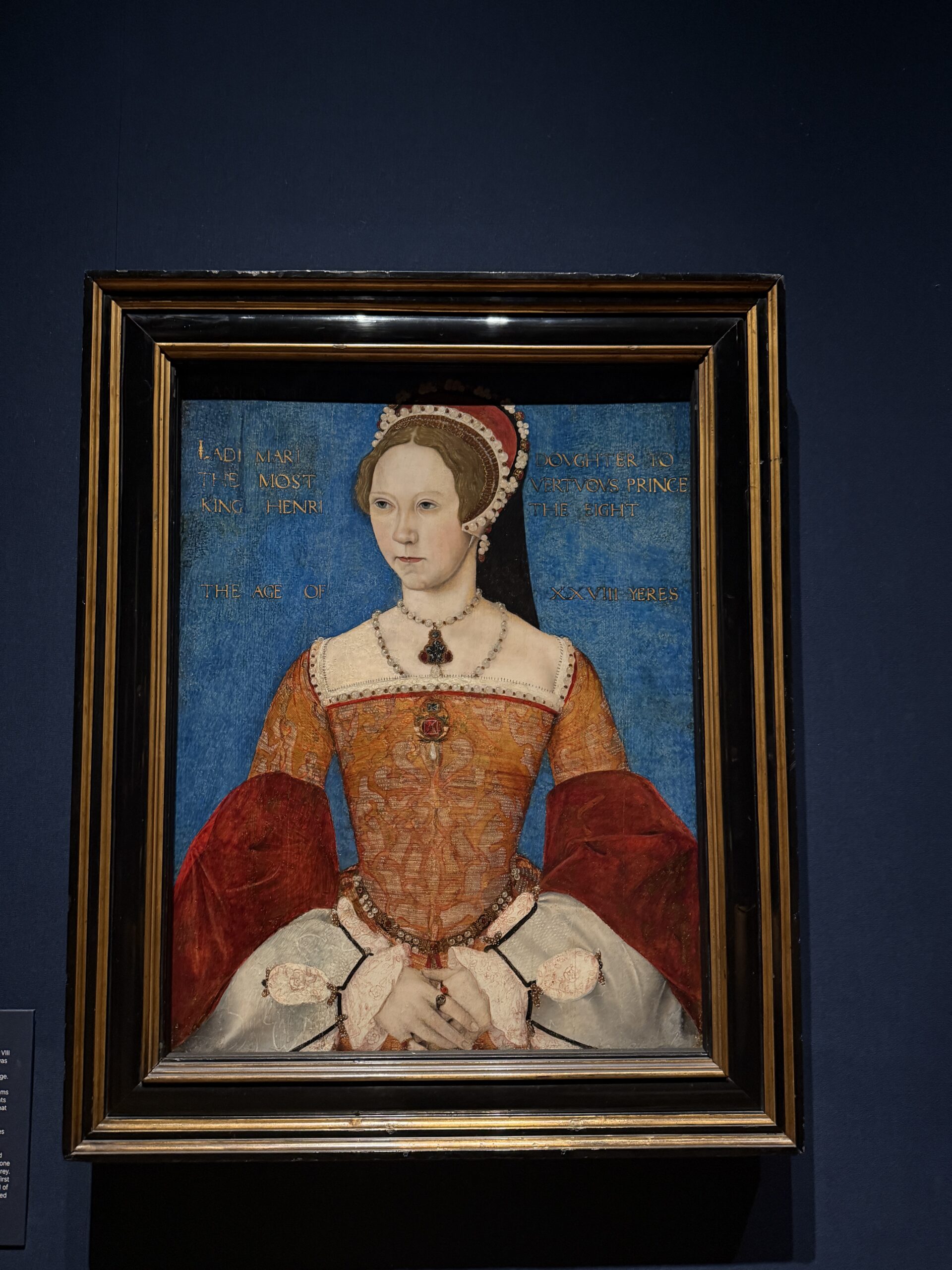
There is a name in the long, turbulent chronology of the Tudor dynasty that immediately evokes images of stakes and fanaticism. Yet, the figure of Mary I of England is far more complex than the moniker history assigned to her. To understand the true story of “Bloody Mary” is to delve into the life of a woman who, before ever becoming a controversial sovereign, was a betrayed princess and a survivor. In this article, we will explore how Mary I Tudor transitioned from being Henry VIII’s “pearl” to becoming England’s first reigning queen, peeling back the layers of her black legend.
Yet Mary I was so much more. She was the first woman to rule England with full sovereign powers, the daughter of a repudiated and humiliated mother, a child prodigy transformed by history into a pawn, and finally a queen who tried by any means necessary—including the wrong ones—to rebuild a world that had been torn away from her. This is her story. It is well worth telling in full.
1. A Princess’s Childhood—And Its End
Mary was born on 18 February 1516 at the Palace of Placentia in Greenwich. As the only surviving child of Henry VIII and Catherine of Aragon, Mary embodied the hopes of the dynasty for years. Described as a strikingly beautiful child, blessed with the characteristic red-gold hair of the Tudors and her mother’s fair complexion, Mary soon proved to be an intellectual prodigy.
Under the guidance of the Spanish humanist Juan Luis Vives, she received an education few women of her era could dream of. At just four years old, she entertained foreign delegations by masterfully playing the virginals; by nine, she could read and write fluently in Latin, navigating the texts of Cicero and the Church Fathers. For nearly two decades, she was the “Pearl of the Realm,” the heir presumptive whom her father adored… until his desire for a male heir and the shadow of Anne Boleyn changed everything.
2. The Dark Years: From Heir to Illegitimate Daughter
The crisis known as “The King’s Great Matter” destroyed Mary’s life. When Henry VIII broke with Rome to marry Anne Boleyn, Mary suffered a brutal demotion. With the Act of Supremacy in 1534, her parents’ marriage was declared null and void: Mary was suddenly branded illegitimate, losing her title of princess to become simply “Lady Mary.”
She was separated from her mother, whom she would never see again, and forced to serve as a maid of honor to her infant half-sister, Elizabeth. This period of humiliation, isolation, and death threats forged her character: Mary clung to the Catholic faith not merely as doctrine, but as the sole remaining link to her identity and the memory of her mother.
3. The Road to the Throne: A Legitimate Coup
Upon Henry VIII’s death in 1547, the crown passed to the young Edward VI, under whom England shifted toward radical Protestantism. On his deathbed, Edward attempted to alter the succession established by his father, bypassing Mary (a Catholic) in favor of his Protestant cousin, Lady Jane Grey.
Yet Mary demonstrated unexpected political courage. Rather than fleeing, she rallied her supporters in East Anglia, challenged the powerful Duke of Northumberland, and marched on London. The English people, viewing her as Henry’s only legitimate heir, acclaimed her queen on 19 July 1553. Mary I Tudor was officially the first woman to govern England with full sovereign authority—a precedent that ultimately paved the way for the very sister, Elizabeth, who now casts a shadow over her memory.
4. The Reign: Catholic Restoration and Reginald Pole
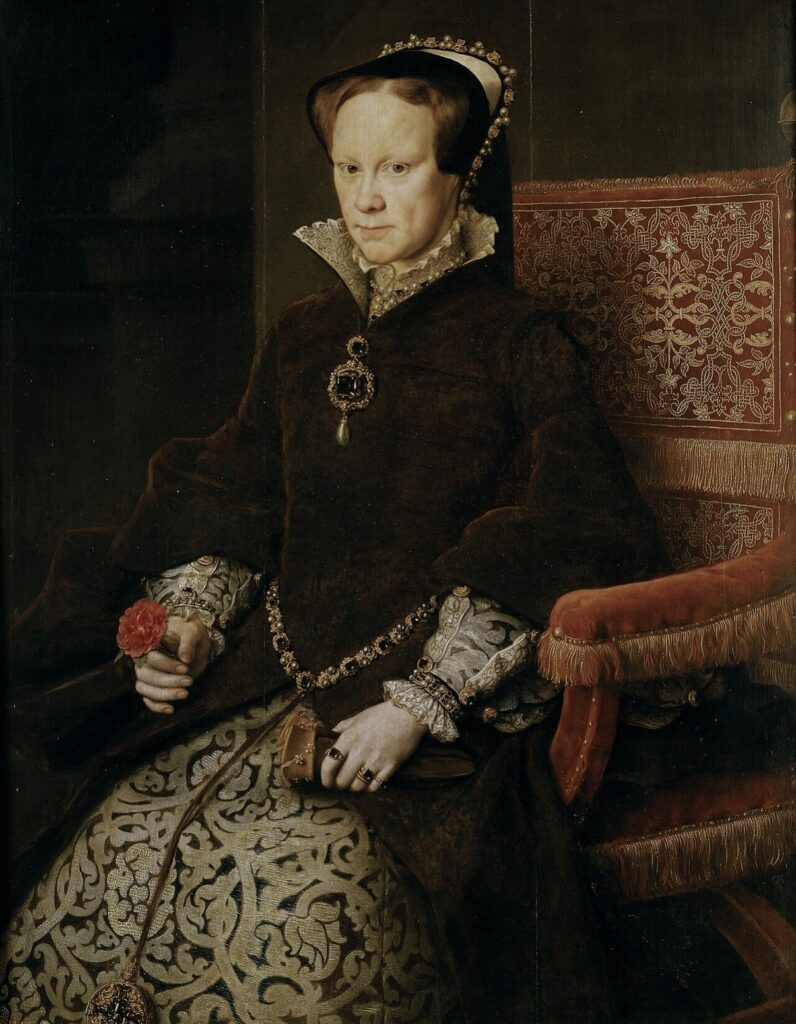
Mary’s reign had one primary objective: reconciliation with Rome. It was neither an immediate nor an easy process. In November 1554, Cardinal Reginald Pole, the queen’s cousin and England’s last great Catholic humanist, returned from exile as Papal Legate to formally absolve the realm of the schism.
Pole, who became Archbishop of Canterbury in 1556 following the deposition of the Protestant Thomas Cranmer, worked closely with Mary to rebuild the infrastructure of the Catholic Church. Mary sought not only to impose dogma but to reform the clergy from within, anticipating many themes of the European Counter-Reformation.
5. Bloody Mary: The Fires and the “Black Legend”
Beginning in 1555, Mary’s reign was stained by the blood that earned her infamous moniker. Approximately 284 people were condemned to the stake for heresy. Notable victims included bishops Latimer, Ridley, and Thomas Cranmer himself, who died at Smithfield proclaiming his faith.
However, it is vital to analyze these numbers through a historical lens:
- Religious persecution was standard practice in 16th-century Europe (witness the massacres of Huguenots in France).
- Henry VIII and Elizabeth I both executed hundreds of subjects for religious dissent, though they frequently labeled them “traitors” rather than “heretics.”
- The legend of “Bloody Mary” was heavily amplified by John Foxe’s Book of Martyrs, a work of Protestant propaganda that became a bestseller under Elizabeth’s reign, cementing Mary’s image as a bloodthirsty monster for centuries.
6. Marriage to Philip II of Spain and Titian’s Portrait
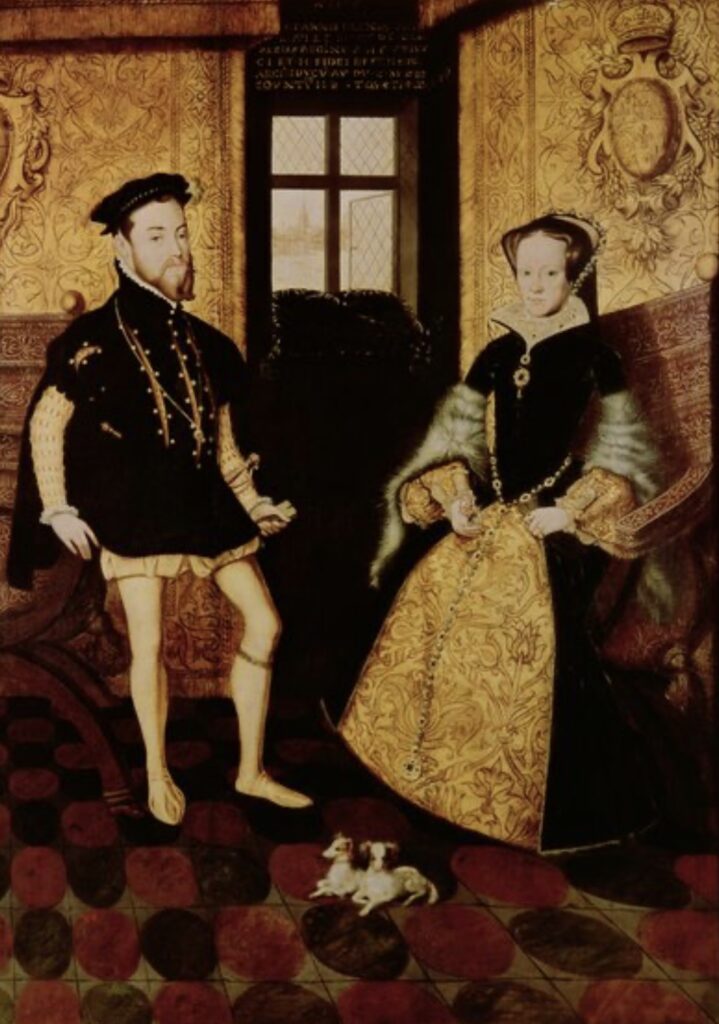
To secure the future of Catholicism, Mary needed an heir. Her choice fell upon Philip II of Spain, son of her powerful cousin Charles V. Mary fell in love with the Spanish prince even before meeting him, captivated by Titian’s famous portrait of Philip. In that painting, Philip appeared as the young, regal defender of the faith; Mary was enchanted, hoping to find in him not just a political ally, but the companionship she had always lacked.
The marriage, celebrated in Winchester Cathedral in 1554, proved to be an emotional disaster. Philip, much younger than his bride, did not reciprocate her feelings and viewed England merely as a pawn against France. Her husband’s icy detachment was a silent humiliation that wore down Mary’s already fragile health.
7. Phantom Pregnancies and the Tragedy of Calais
Mary’s deepest sorrow was her phantom pregnancies. Twice, in 1555 and 1558, the queen exhibited all the physical signs of gestation, yet the months passed without a child being born. These episodes, today attributed by medical historians to possible ovarian tumors or endocrine imbalances, were experienced by Mary as divine punishment.
Compounding this personal heartbreak was military disaster: in January 1558, England lost Calais, its final continental possession. It was a crushing blow to national prestige. Legend holds that on her deathbed, Mary confessed: “When I am dead and opened, you shall find Calais lying in my heart.”
8. The End of a Reign, the Beginning of a Legend
Mary I of England died on 17 November 1558, at just 42 years of age, likely from a tumor exacerbated by an influenza epidemic. Despite the pain of her sister’s religious defiance, Mary resisted her council’s pressure to have Elizabeth executed, officially naming her as her successor to the throne.
Today, in Westminster Abbey, the two sisters rest in the same tomb. The epitaph chosen by James I reads: “Regno consortes et urna, hic obdormimus Elizabetha et Maria sorores, in spe resurrectionis” (Consorts in realm and tomb, here we sleep, two sisters, Elizabeth and Mary, in the hope of resurrection).
Mary I Tudor was not merely “Bloody Mary.” She was a woman of exceptional culture, a queen who governed with courage in a man’s world, and a tragic figure who sought—using tools often cruel yet consistent with her era—to save her country’s soul. She deserved, and still deserves, to be remembered for the complexity of her life, rather than the horror of a moniker.