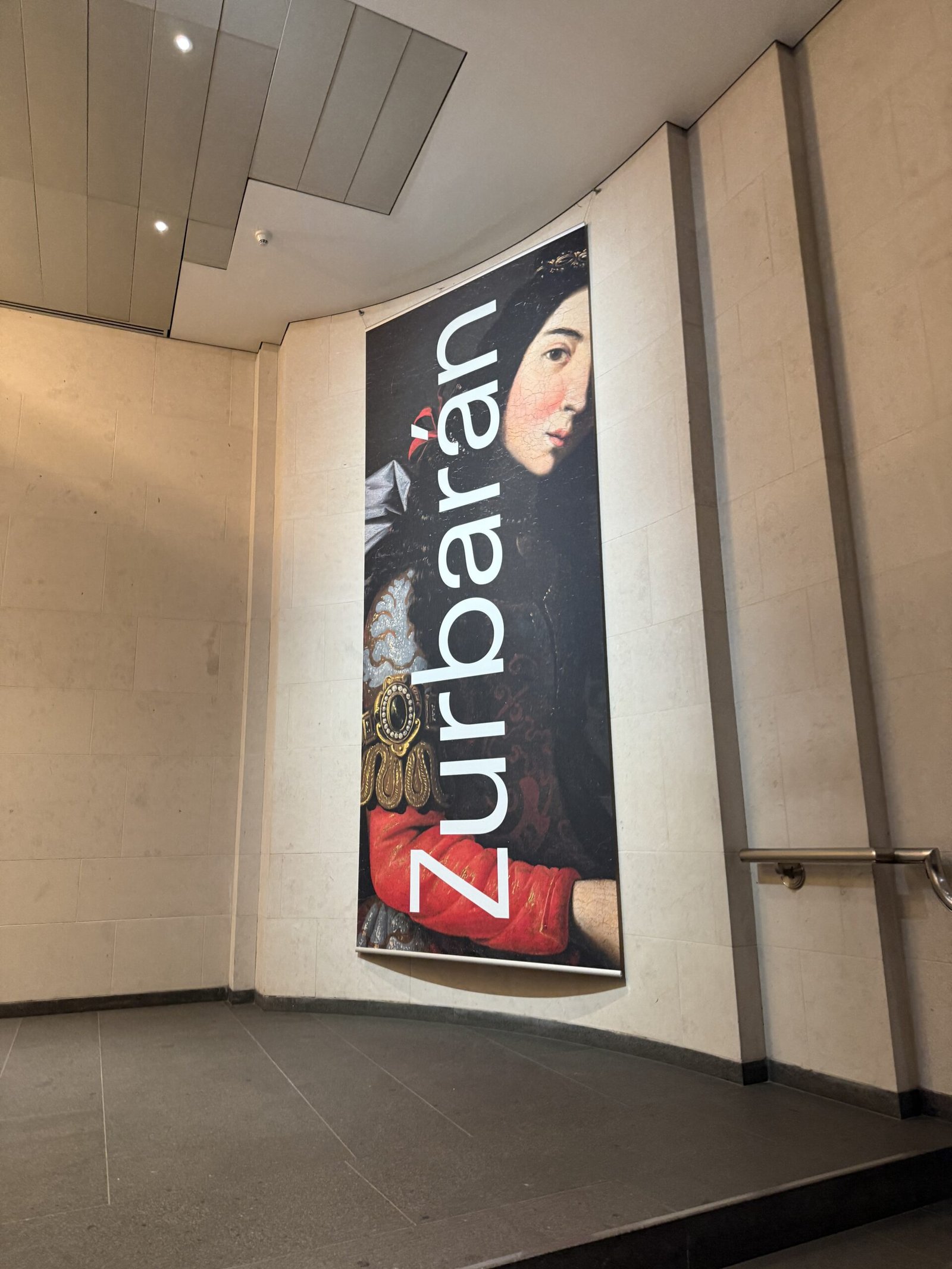
Before visiting the National Gallery’s exhibition, I knew Francisco de Zurbarán primarily through reproductions. I was familiar with the intensity of his religious paintings, his dramatic use of light and, of course, the National Gallery’s own Saint Margaret of Antioch. Yet seeing his works gathered together revealed an artist far more varied and surprising than I had expected.
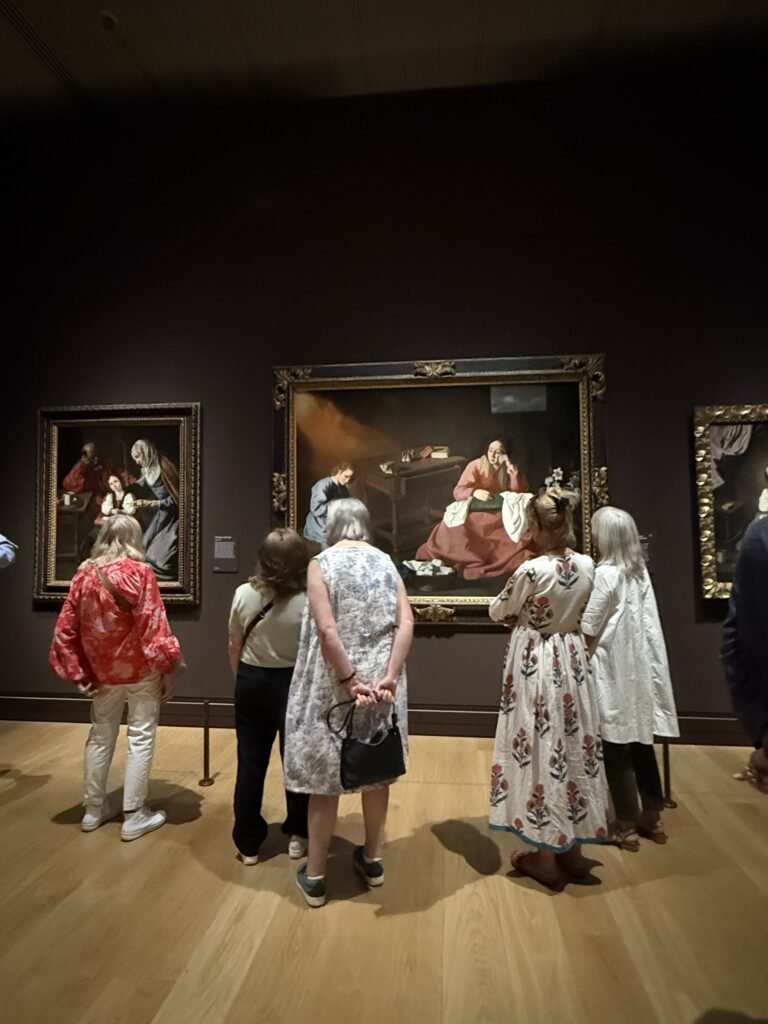
Bringing together more than forty paintings from collections across Europe and the United States, Zurbarán is the first major monographic exhibition devoted to the artist in the UK. It spans his career from the imposing religious commissions that established his reputation in Seville to the quieter works created for private contemplation during his later years. Monumental altarpieces, life-size saints, royal mythologies and intimate still lifes appear side by side, allowing visitors to understand how successfully Zurbarán moved between scale, subject and audience.
What emerges is not simply the portrait of a painter of religious devotion, but that of an acute observer of the physical world. Fabric, skin, fruit, flowers and everyday objects are rendered with such clarity that the sacred often seems to enter our own reality.
Seville, Faith and the Making of an Artist
Zurbarán spent much of his career in seventeenth-century Seville, then a wealthy centre of trade connected to the Americas. Between Velázquez’s departure for Madrid in 1623 and the rise of Murillo in the 1650s, he became one of the city’s leading painters, working extensively for its monasteries and religious orders.
These institutions did not simply require individual devotional pictures. They commissioned large altarpieces and entire cycles intended to communicate the histories, identities and spiritual values of their communities. Zurbarán therefore had to solve complex visual problems: how could a mystical vision be made visible? How could separate earthly and heavenly realities be combined within one composition? And how could a monumental religious narrative remain emotionally direct?
The exhibition introduces these questions through works such as The Apparition of Saint Peter to Saint Peter Nolasco. The subject represents a vision experienced by Peter Nolasco, founder of the Mercedarian Order, in which Saint Peter appears to him crucified upside down. Zurbarán creates a clear division between physical and visionary space, yet the supernatural event possesses the same weight and presence as the kneeling saint who witnesses it. Rather than dissolving into an indistinct heavenly realm, the vision appears startlingly real.
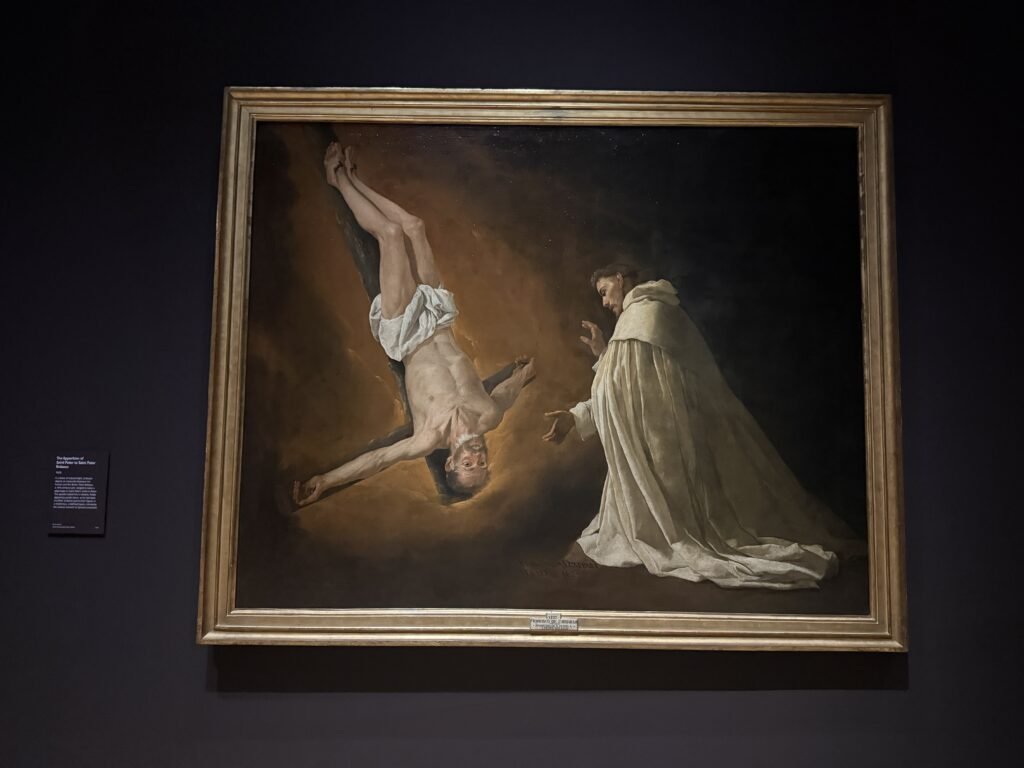
This ability to give spiritual experience a physical form is central to Zurbarán’s art. His figures rarely rely on elaborate settings or theatrical crowds. Instead, he concentrates attention through controlled composition, strong contrasts and carefully selected gestures. The result is an art that can be monumental without becoming chaotic.
Light, Darkness and Caravaggesque Realism
Zurbarán’s early style was shaped by the realism associated with Caravaggio and his followers. The comparison is especially evident in his use of strong directional light, dark backgrounds and figures whose physical presence feels almost sculptural. Yet Zurbarán’s response to this visual language is highly individual.
Where Caravaggio often uses light to intensify movement, conflict or psychological drama, Zurbarán frequently uses it to create stillness. His light isolates rather than disrupts. It falls across a face, a white habit or the folds of a garment, separating the subject from the darkness and directing the viewer towards what matters most.
This is particularly powerful in The Crucifixion of 1627, Zurbarán’s earliest surviving signed and dated painting. Originally made for the Dominican monastery of San Pablo el Real in Seville, it was installed in a dim interior where its illusionism reportedly caused viewers to mistake the painted figure for sculpture. Seen today in a museum, removed from that original architectural and devotional setting, the work still conveys an extraordinary sense of bodily weight and silent suffering.
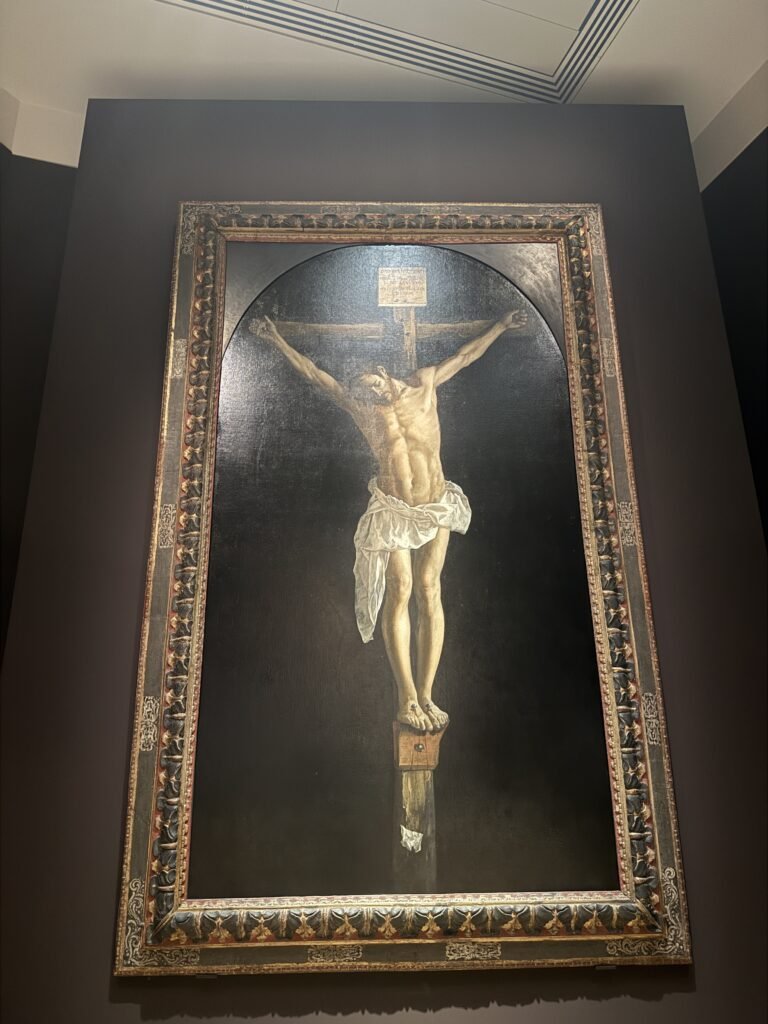
The darkness surrounding Christ removes almost every distraction. There is no animated crowd and no extensive landscape. Instead, the viewer confronts the solitary figure directly. Zurbarán’s realism is not an alternative to spiritual meaning; it is the means through which that meaning becomes emotionally accessible.
A similarly contemplative mood characterises Saint Francis of Assisi. The saint emerges from shadow with a monumentality that seems almost incompatible with the simplicity of his rough habit. Yet it is precisely this contrast—between the humble material of the garment and the imposing presence of the figure—that gives the painting its strength.
Monumental Altarpieces and Religious Storytelling
One of the exhibition’s greatest achievements is its ability to suggest the scale of Zurbarán’s religious commissions. Paintings now dispersed across different museums were originally conceived as parts of much larger decorative programmes, sometimes installed several metres above the viewer.
Three works associated with the vast altarpiece created for the Carthusian monastery of Nuestra Señora de la Defensión in Jerez de la Frontera are reunited here for the first time in more than a century. The Circumcision, The Adoration of the Magi and The Virgin of the Rosary with the Carthusians are believed to have occupied the second level of an altarpiece approximately fifteen metres high.
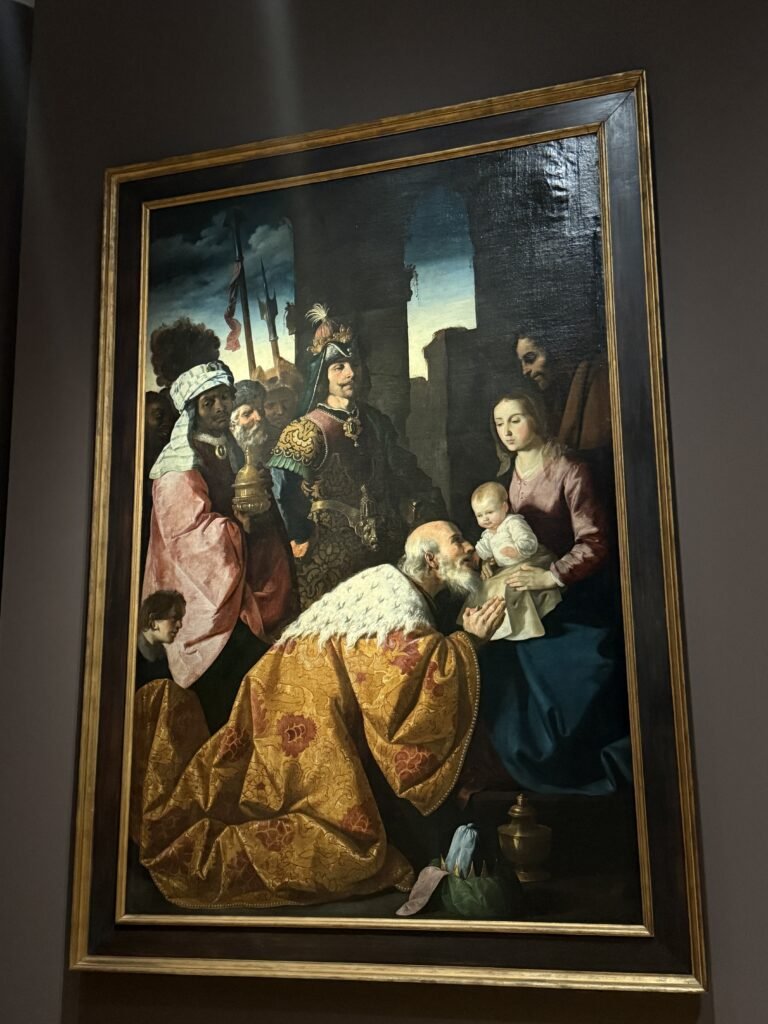
Encountering these paintings at closer range allows us to examine their details, but it also requires us to imagine their intended setting. They were not originally isolated museum objects. Their scale, elevated viewpoints and strongly defined compositions were designed to function within a complex architectural structure and to remain legible from a distance.
This partial reunion is therefore more than an impressive display of large canvases. It helps reconstruct the visual environment for which Zurbarán worked and reminds us how profoundly the meaning of an artwork can be shaped by its original location.
The Fabric of Saints
Despite the power of the altarpieces, I found myself repeatedly returning to Zurbarán’s textiles. Wool, leather, embroidery, fine cord and richly coloured fabrics are all painted with extraordinary precision. Light does not simply illuminate these materials; it reveals their weight, thickness and texture.
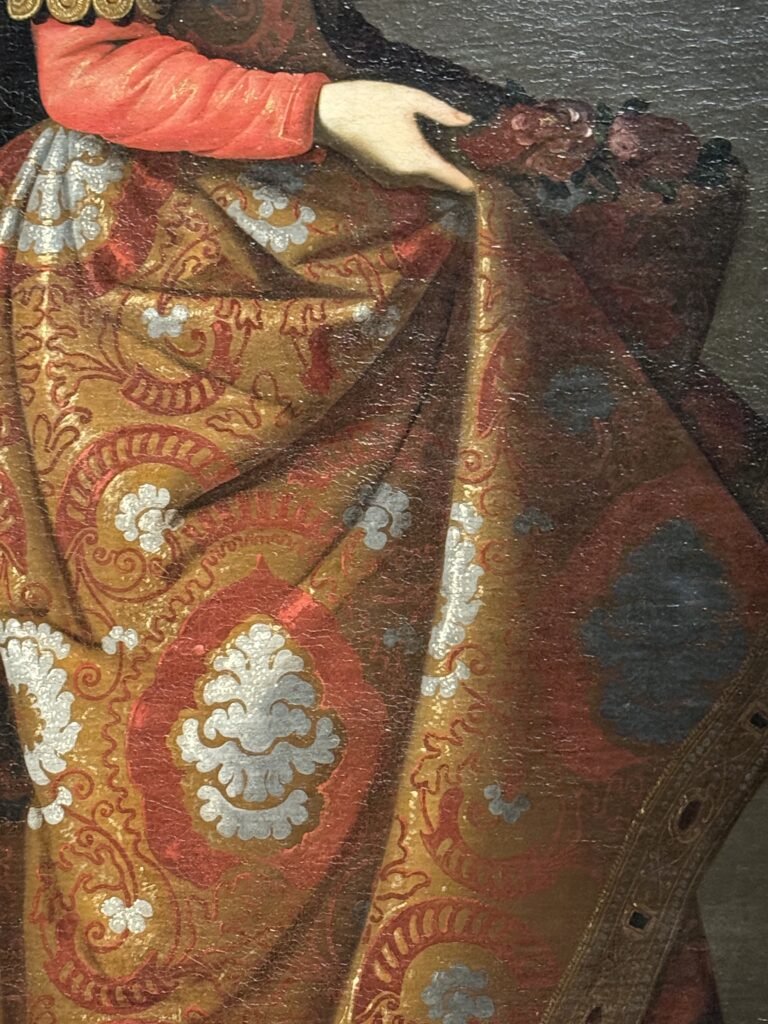
This may partly reflect the world in which the artist grew up. Zurbarán’s father was a haberdasher, and the painter may have become familiar with textiles and thread from an early age. Seville’s religious processions, theatrical performances and ceremonial culture would also have provided a rich visual language of fabrics, costumes and colour.
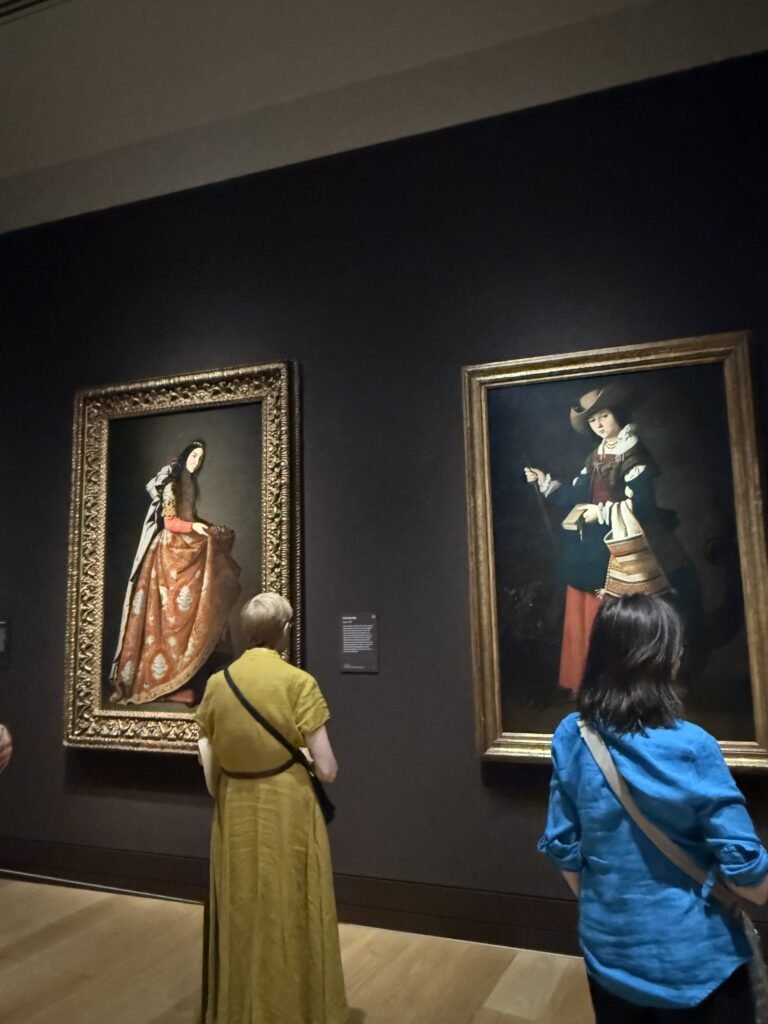
The exhibition’s saints and martyrs are not presented as distant, immaterial beings. Their clothing gives them substance and places them within a recognisable material world. This is especially apparent in Saint Casilda, whose elaborately patterned costume dominates the composition. Her richly dressed figure appears almost like a court portrait, yet the roses she holds refer to the miracle through which the food she was secretly carrying to Christian prisoners was transformed into flowers.
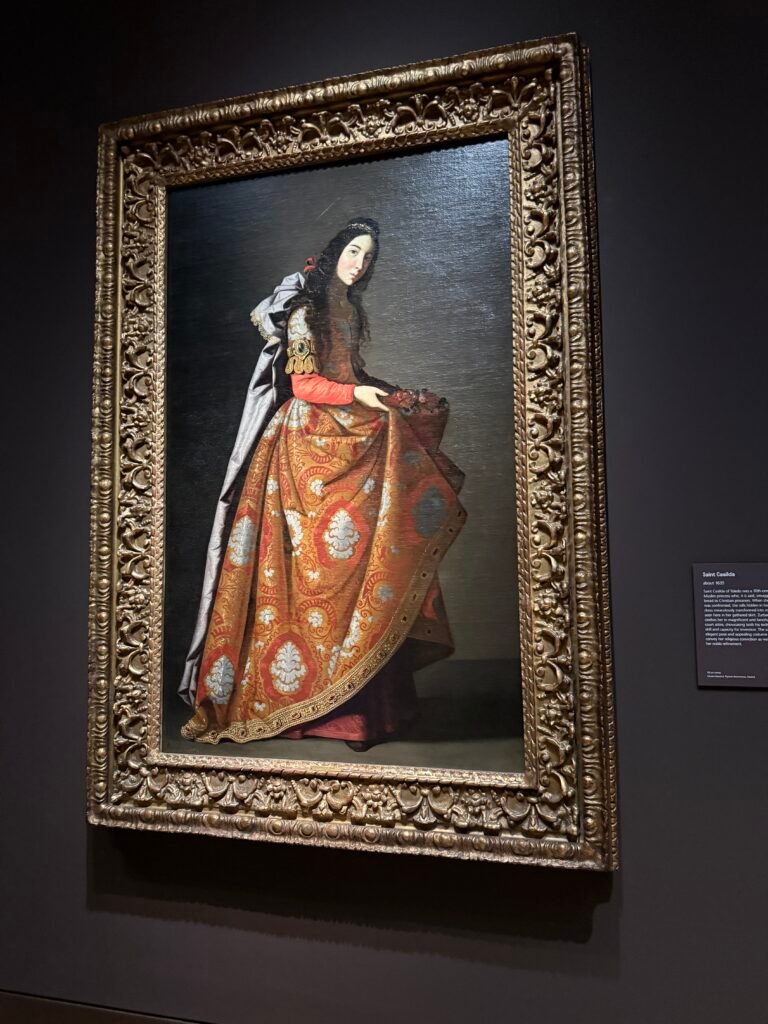
I was struck by the tension between the splendour of her clothes and the spiritual story they accompany. Zurbarán does not treat material beauty as an obstacle to devotion. Instead, fabric becomes part of the saint’s identity and a means of capturing the viewer’s attention.
The National Gallery’s Saint Margaret of Antioch produces a similar effect. Rather than depicting the martyr in an abstract or timeless form, Zurbarán presents her as a poised young woman wearing an elaborate contemporary costume. Her staff and the dragon beside her identify the saint, but it is her physical presence—and the remarkable construction of her garments—that makes the encounter so immediate.
Perhaps this aspect of Zurbarán’s work resonated especially strongly with me because of my background in photography. Light is never merely illumination: it defines form, separates textures and creates atmosphere. Zurbarán understands precisely how light can turn a fold of cloth into something almost tangible. Looking closely at these paintings, I became increasingly aware that fabric is not a decorative addition to the narrative. It is one of his most expressive visual languages.
Saints, Patriarchs and Political Meaning
The life-size figures of Joseph and Asher, from Zurbarán’s series Jacob and His Twelve Sons, reveal another dimension of his art. Each of Jacob’s sons is represented as an individual, distinguished through clothing, attributes and gesture. Displayed at near human scale, the figures occupy the viewer’s space with the presence of portraits, despite representing biblical patriarchs.
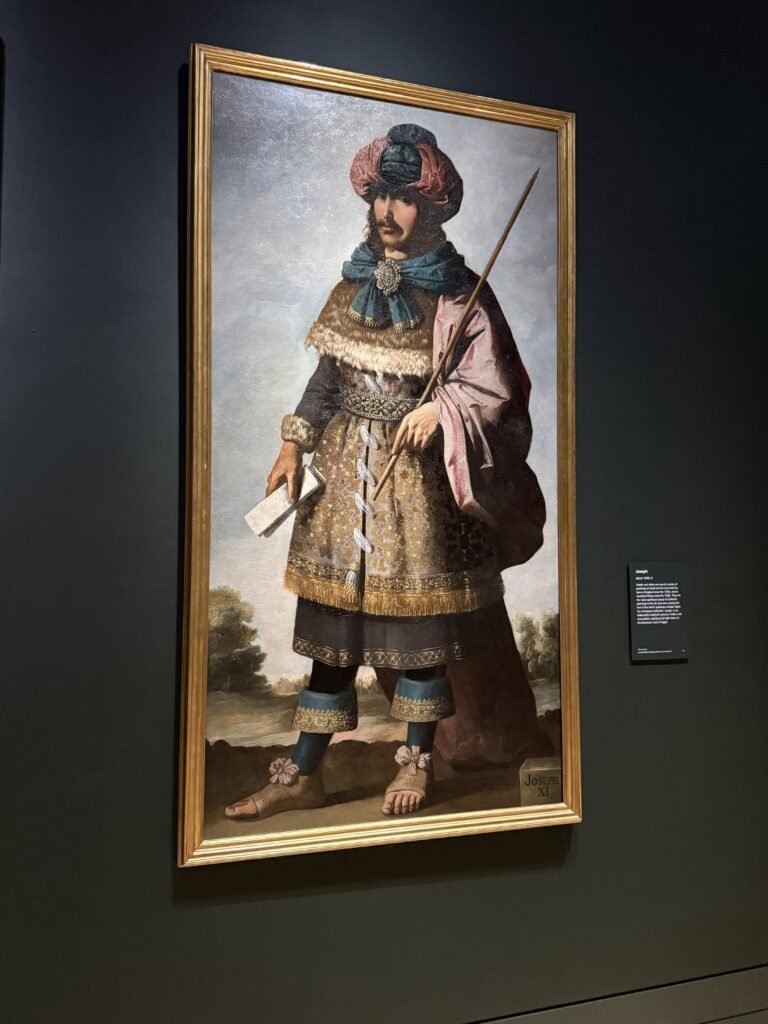
The series also has an important British history. Twelve of the thirteen paintings were acquired in 1756 by Richard Trevor, Bishop of Durham, and installed at Auckland Castle. Their display has been associated with Trevor’s support for Jewish rights in Britain, giving the paintings a political significance far removed from the Spanish context in which they were created.
Seeing Joseph and Asher within the broader exhibition helps connect Zurbarán’s command of costume and character with the power of display itself. These are religious figures, but they also demonstrate how life-size images can communicate identity, dignity and authority across different historical settings.
Beyond Seville: Zurbarán at the Royal Court
Although Zurbarán is most closely associated with Seville’s religious institutions, his career was not confined to devotional painting. In 1634, he travelled to Madrid to contribute to the decoration of Philip IV’s new Buen Retiro Palace.
For the Hall of Realms, Zurbarán painted a series depicting the Labours of Hercules. The inclusion of works such as Hercules and Cerberus and Hercules and the Cretan Bull is particularly revealing because their muscular mythological subjects appear far removed from his contemplative monks and saints.
Yet they also demonstrate his adaptability. Hercules was presented as an ancient predecessor of the Spanish monarchy, and the series formed part of a wider decorative programme celebrating royal power. The paintings therefore expand our understanding of Zurbarán: he was not only a painter of monastic devotion, but an artist capable of contributing to one of the most politically significant artistic projects of Philip IV’s reign.
Stillness in Everyday Objects
The still-life room provides one of the exhibition’s most beautiful changes of pace. Francisco de Zurbarán is believed to have painted relatively few independent still lifes, making the opportunity to see several examples together particularly valuable.
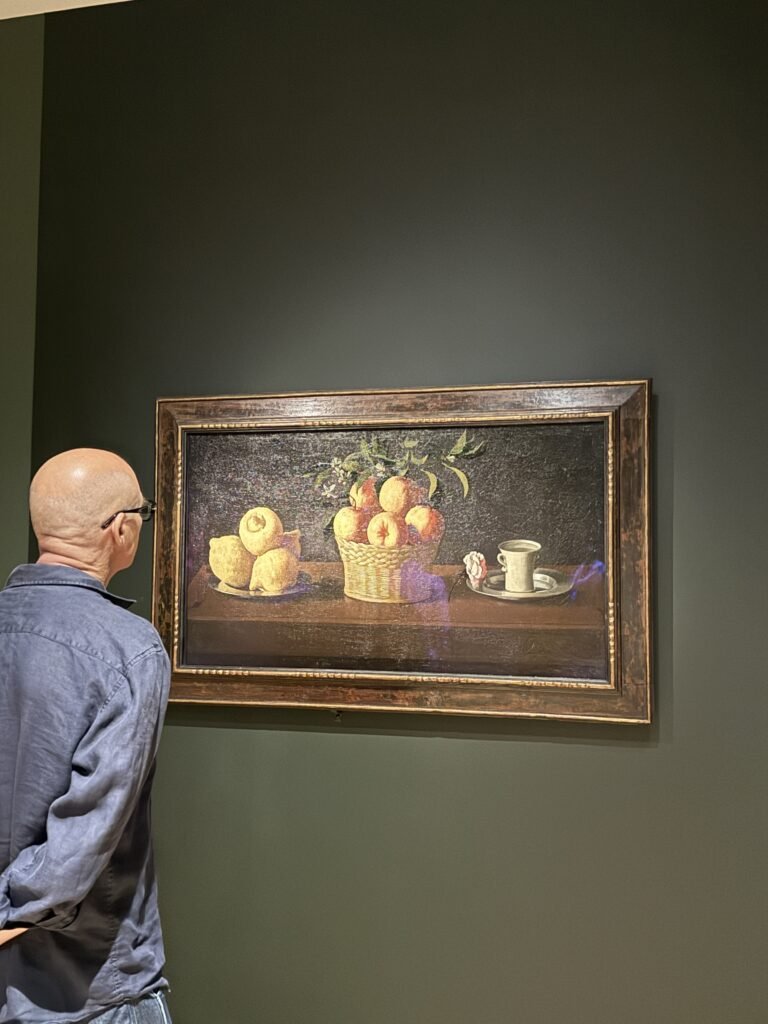
In Still Life with Lemons, Oranges and a Rose, the objects are arranged with remarkable restraint. Each group is carefully separated, while the dark background and concentrated light give fruit, flowers and vessels an unusual gravity. Nothing appears casual, yet the composition never feels artificial. Ordinary things are observed with the same intensity that Zurbarán brings to the faces and garments of his saints.
Displayed alongside the National Gallery’s A Cup of Water and a Rose, the painting demonstrates how little Zurbarán needed to create an atmosphere of contemplation. A cup, a flower or the textured skin of a lemon becomes worthy of sustained attention.
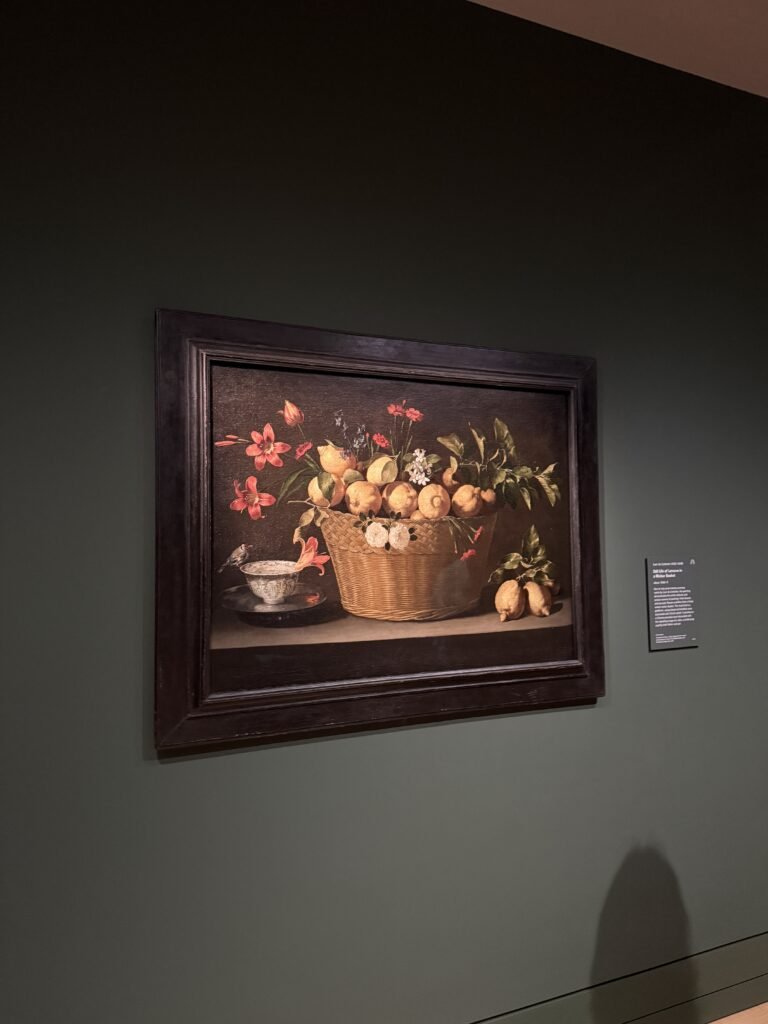
The exhibition also introduces the still lifes of his son, Juan de Zurbarán, whose short career ended when he died during the plague that struck Seville in 1649. Juan’s paintings are more abundant and decorative, but they share his father’s sensitivity to texture and light. Their inclusion prevents the still-life section from feeling like an isolated interlude and instead opens a fascinating dialogue between two artists working within the same family and city.
Private Devotion and a Quieter Final Note
The later sections turn towards smaller paintings intended for private devotion. Works such as Agnus Dei show Zurbarán reducing religious imagery to its most concentrated form. A bound lamb lies against a dark background, painted with extraordinary tenderness and precision. The simplicity of the composition makes the symbolism more, rather than less, powerful.
These intimate pictures reveal a different relationship between artwork and viewer. The monumental altarpieces were created for architectural spaces and religious communities; these smaller works invite individual contemplation at close range. Yet across both formats, Zurbarán retains the same ability to make physical reality carry spiritual meaning.
This progression—from vast public commissions to quiet devotional images—gives the exhibition a satisfying emotional rhythm. It also shows that Zurbarán’s stillness was not a limitation or a repeated formula. He adapted it to different scales and purposes throughout his career.
Curating Zurbarán for a Contemporary Audience
Presenting seventeenth-century Spanish devotional painting to a modern international audience is not straightforward. Many visitors may be unfamiliar with the saints, monastic orders and theological debates represented in the works. Without context, their iconography can feel remote.
The exhibition responds by combining clear interpretation with generous visual space. Rather than attempting to explain every symbol before the viewer has had time to look, the display allows the paintings to establish their own physical and emotional presence. Historical information then deepens the encounter by reconnecting the works to their patrons, original locations and devotional functions.
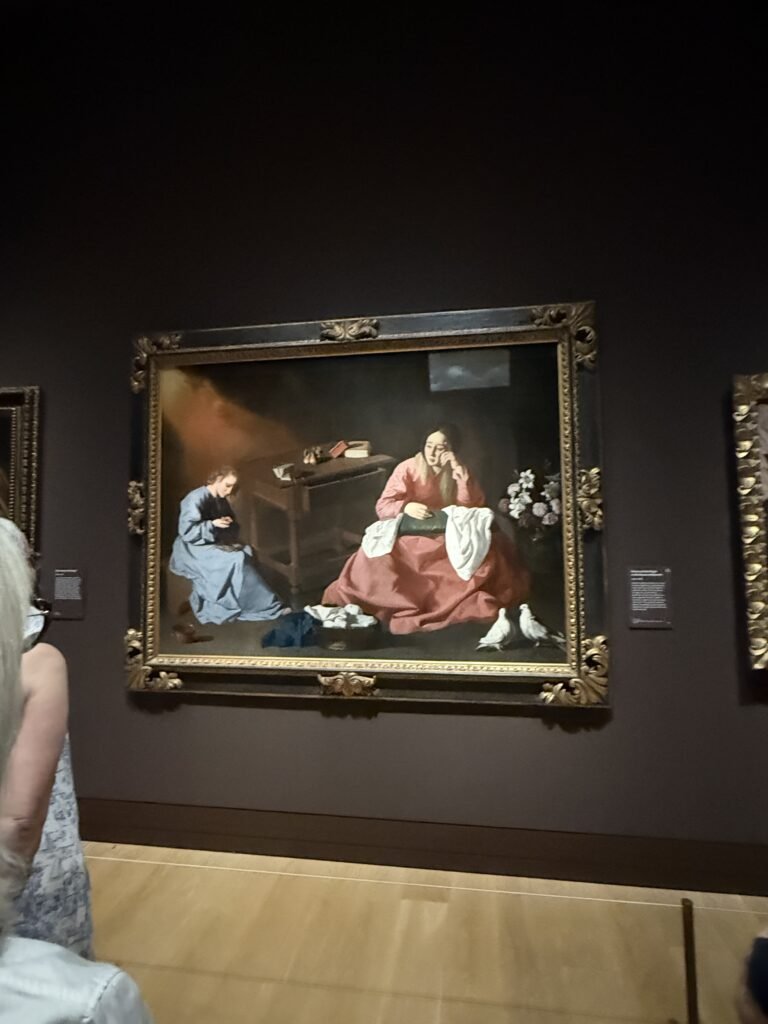
The thematic and broadly chronological structure also avoids reducing Zurbarán to a single recognisable style. Moving from religious commissions and saintly figures to royal mythology, still life and private devotion reveals both continuity and change. His commitment to close observation remains constant, but its purpose shifts according to subject and setting.
For me, the partial reconstruction of dispersed commissions is particularly valuable. Museums inevitably transform altarpiece panels and devotional images into independent works of art. By reuniting paintings and explaining their relationship to lost or altered settings, the exhibition encourages visitors to consider not only what they are seeing, but how and where these works were originally meant to be experienced.
A Lasting Impression
I entered the exhibition expecting to admire Zurbarán’s command of dramatic light. I left thinking just as much about fabric, scale and stillness.
What makes his work so compelling is the way he brings the physical and spiritual worlds together. A coarse habit, an embroidered sleeve, a bound lamb or a bowl of fruit is never merely a technical demonstration. Each material detail contributes to the emotional and symbolic force of the image.
The exhibition also confirmed something that reproductions can never fully communicate: Zurbarán’s paintings depend on presence. Their scale changes our relationship with the figures; their darkness seems deeper; their textures become almost touchable. Standing before them, we become conscious of our own act of looking.
This first major UK exhibition devoted to Zurbarán succeeds because it presents both the familiar intensity of his religious art and the breadth of a career that extended far beyond it. It introduces us to a painter of monumental commissions, individual saints, political mythologies, intimate devotional works and some of the most compelling still lifes of the Spanish Baroque.
Above all, it asks us to slow down. In a world in which images are often consumed in seconds, Zurbarán reminds us that looking closely is not a passive act. It is a way of discovering how light, material and human presence can transform even the quietest image into something unforgettable.